

The ARTIFICIALIRIS for patients with aniridia
The ARTIFICIALIRIS from HumanOptics is the world’s unique foldable iris prosthesis, for both medical and aesthetic reconstruction of eyes with complete or partial aniridia.
- Two color options: Individual customized coloring or selection of predefined color combination
- Injectable
- Versatile
- Controlled light entry: fixed pupil aperture and opaque material
- Biocompatible
The CUSTOMFLEX® ARTIFICIALIRIS from HumanOptics Holding AG has received FDA approval. This makes it the only product of its kind currently approved in the US market addressing medical needs not yet served there.
IMPORTANT NOTE:
The ARTIFICIALIRIS from HumanOptics is not intended for a cosmetic change of eye color. The product is developed for implantation in the posterior chamber of the eye and is not suitable for placement in the anterior chamber. It is strongly recommended that the ARTIFICIALIRIS from HumanOptics is implanted only after removal of the natural lens and IOL implantation. Please note that not all products are available in all countries.
The ARTIFICIALIRIS is indicated for use in adults and children from 6 years for the treatment of full or partial aniridia resulting from congenital aniridia, acquired defects, or other conditions associated with full or partial aniridia.
ARTIFICIALIRIS by HumanOptics
Model description
Application
ARTIFICIALIRIS Fiber Free
Developed for cases without suture fixation. Suture fixation possible with appropriate technique.
ARTIFICIALIRIS with Fiber
For aniridia cases where suturing is indicated.
Material
Pigmented silicone elastomer without polymer fiber meshwork
Pigmented silicone elastomer with polymer fiber meshwork
Diameter
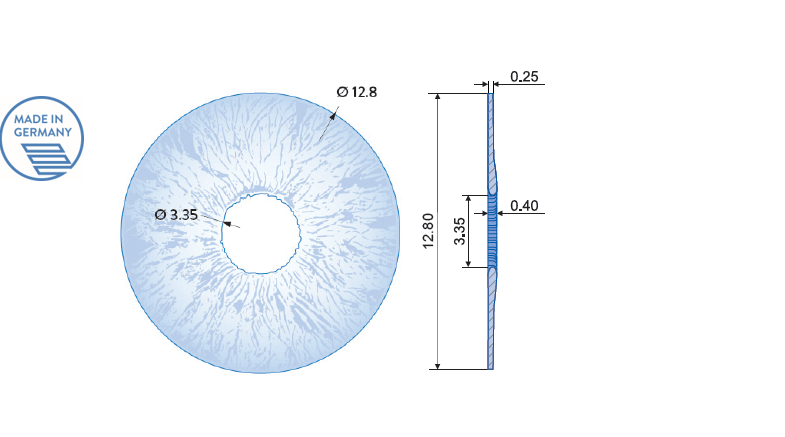
Total diameter: 12.8 mm
Pupil diameter: 3.35 mm
Total diameter: 12.8 mm
Pupil diameter: 3.35 mm
Color ARTIFICIALIRIS SELECT
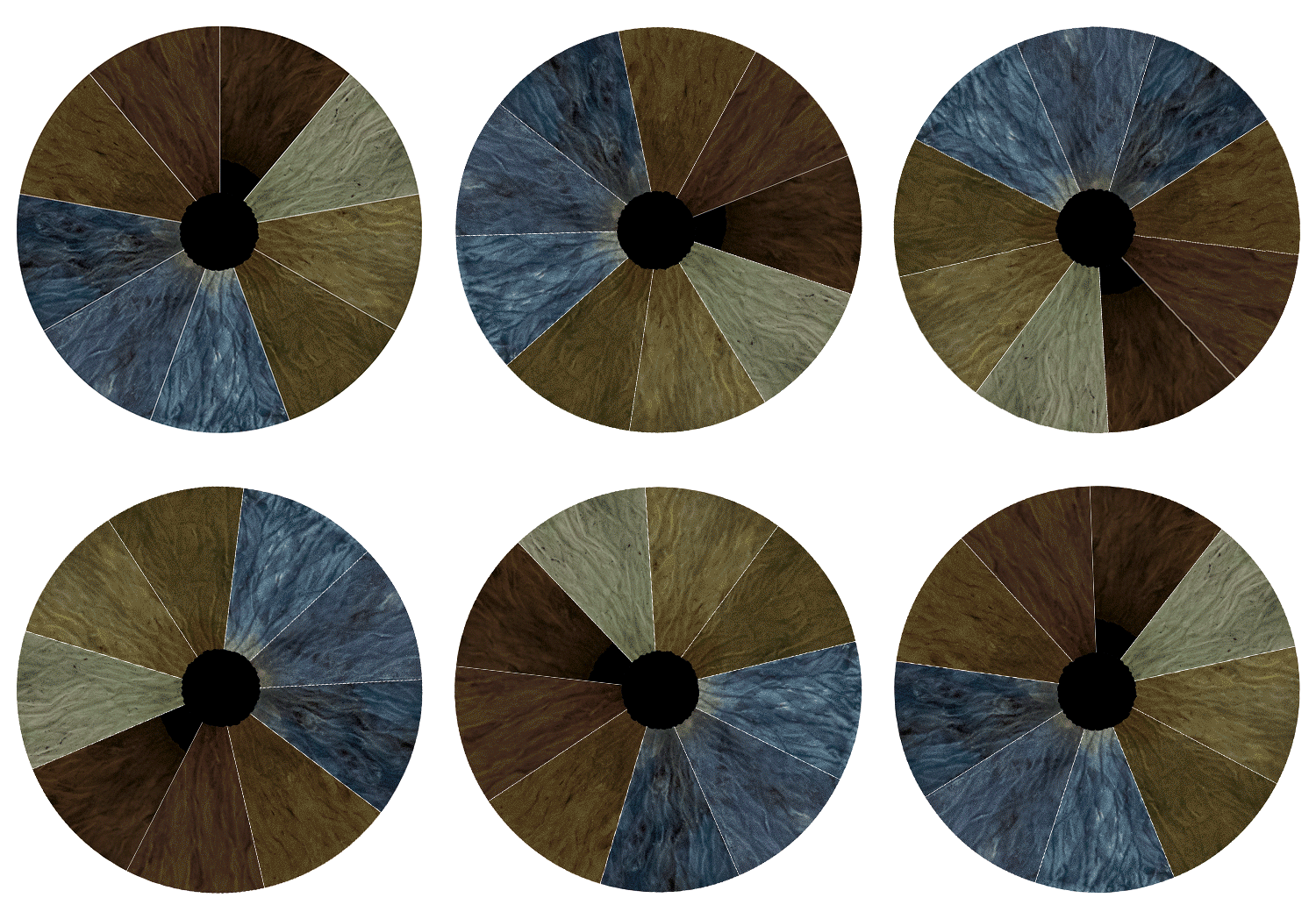
Available in 9 different predefined multicolor SELECT color variations:
• Select Light Brown, Select Medium Brown, Select Dark Brown
• Select Light Blue, Select Medium Blue, Select Dark Blue
• Select Light Green, Select Medium Green, Select Dark Green
Available in 9 different predefined multicolor SELECT color variations:
• Select Light Brown, Select Medium Brown, Select Dark Brown
• Select Light Blue, Select Medium Blue, Select Dark Blue
• Select Light Green, Select Medium Green, Select Dark Green
Color CUSTOMFLEX® ARTIFICIALIRIS
The design is based on the labeled photo printout (hard copy) serving as color target for the individual production and resembling the natural iris.
The design is based on the labeled photo printout (hard copy) serving as color target for the individual production and resembling the natural iris.
Specifics
The diameter of the implant can be individually trephined. The model ArtificialIris Fiber Free can be injected through qualified injector systems.
The diameter of the implant can be individually trephined. The model ArtificialIris Fiber Free can be injected through qualified injector systems.
Availability
The delivery time of the CUSTOMFLEX® ARTIFICIALIRIS is to be confirmed individually on request. The ARTIFICIALIRIS SELECT is in stock for fast and urgent patient care.
The delivery time of the CUSTOMFLEX® ARTIFICIALIRIS is to be confirmed individually on request. The ARTIFICIALIRIS SELECT is in stock for fast and urgent patient care.
ARTIFICIALIRIS by HumanOptics
The solution for your patients with aniridia
The natural iris plays an important role in the optical system of the eye and also gives our eyes their color and influences our personal appearance. Aniridia therefore not only reduces optical quality due to photophobia, aberration errors, glare, and the loss of depth of field, but it also has a negative effect on the appearance and thus on the quality of life of the patient.
Aetiology
Complete or partial aniridia can be congenital or acquired by trauma or diseases.
Impairment caused by aniridia
- Loss of vision
- Increased sensitivity to glare
- Loss of depth of focus
- Negative impact on the quality of life
Why the ARTIFICIALIRIS?
The ARTIFICIALIRIS from HumanOptics represents an ideal treatment option for patients with complete and partial aniridia. The foldable iris implant provides both medical and aesthetic rehabilitation.
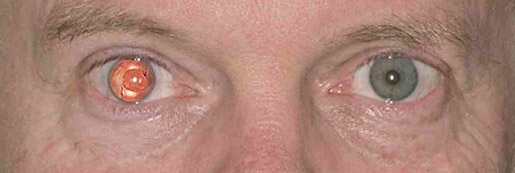
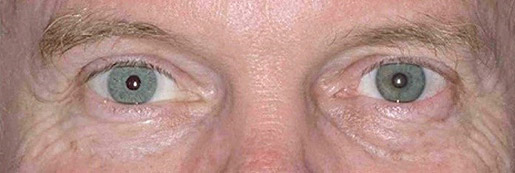
(Pictures courtesy of Kevin M. Miller, MD, Jules Stein Institute, University of California, Los Angeles, USA)
The ARTIFICIALIRIS Color Categories
Find your match
The ARTIFICIALIRIS from HumanOptics is available in two different color options: Individual customized coloring (CUSTOMFLEX® ARTIFICIALIRIS) or a selection of a predefined color combination (ARTIFICIALIRIS SELECT).
ARTIFICIALIRIS SELECT
The color category ARTIFICIALIRIS SELECT is available in BROWN | BLUE | GREEN each in three different graduations LIGHT | MEDIUM | DARK

Your benefits:
Premium Quality
- Unique, 3D-structured, completely handmade iris
- Available in 9 different multicolor predefined color combinations
Fast Delivery
- In stock and directly available for fast and urgent patient care
Easy Order
- No photo of the patient’s eye is required
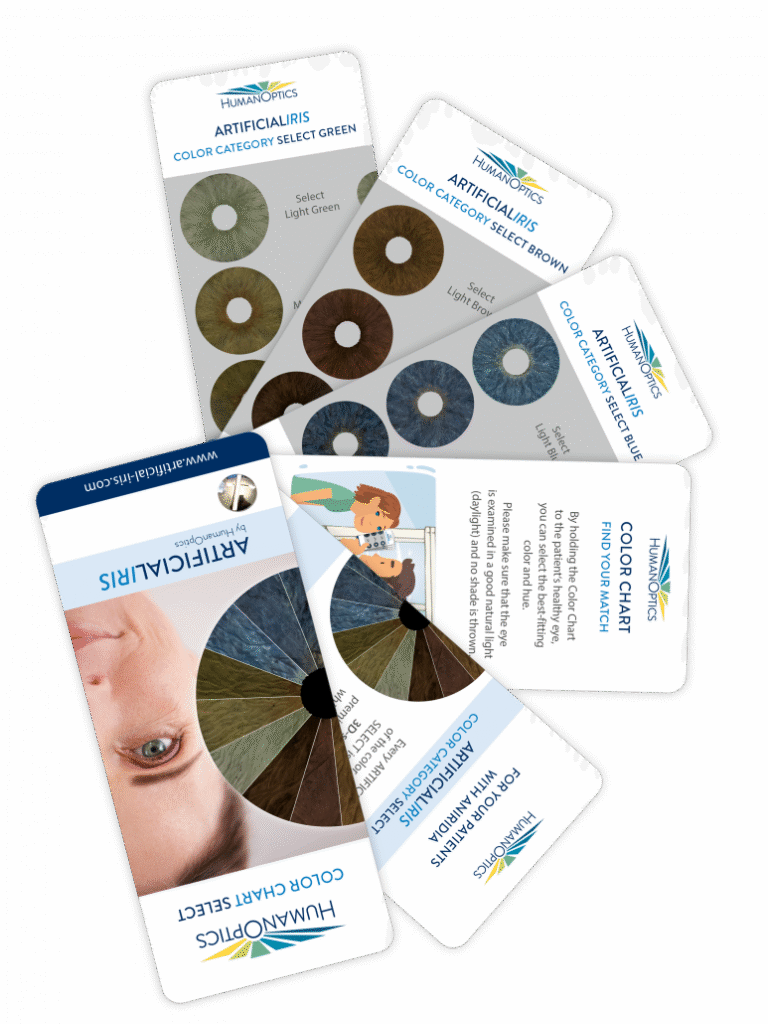
By holding the special designed HumanOptics Color Chart SELECT to the patient’s healthy eye, the surgeon can select the right patient related color match. Please insert the desired color code on the ARTIFICIALIRIS SELECT order form.
IMPORTANT NOTE:
Please use for color selection only the HumanOptics Color Chart SELECT (V2.0/2023-07). The color of the prints in the Color Chart may deviate slightly from that of the actual product due to the manual coloring process during pro
No color match found?
DISCOVER THE CUSTOMFLEX® ARTIFICIALIRIS
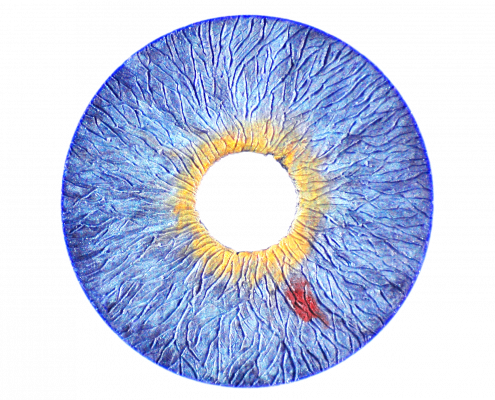
The CUSTOMFLEX® ARTIFICIALIRIS is a unique treatment option of its kind for patients with aniridia. The aesthetic rehabilitation with the custom-made iris implant leads to a very high patient satisfaction and contributes significantly to the improvement of the quality of life of aniridia patients.
- Custom-made
- Based on the natural structure and personal colouring of the patient’s original iris
- Impressively realistic results
“HumanOptics made my iris and since these my life has drastically changed. I am now able to drive. My vision has improved greatly. But the biggest thing for me is that I now feel normal.”
Patient statement after implantation of CUSTOMFLEX® ARTIFICIALIRIS
Medical rehabilitation
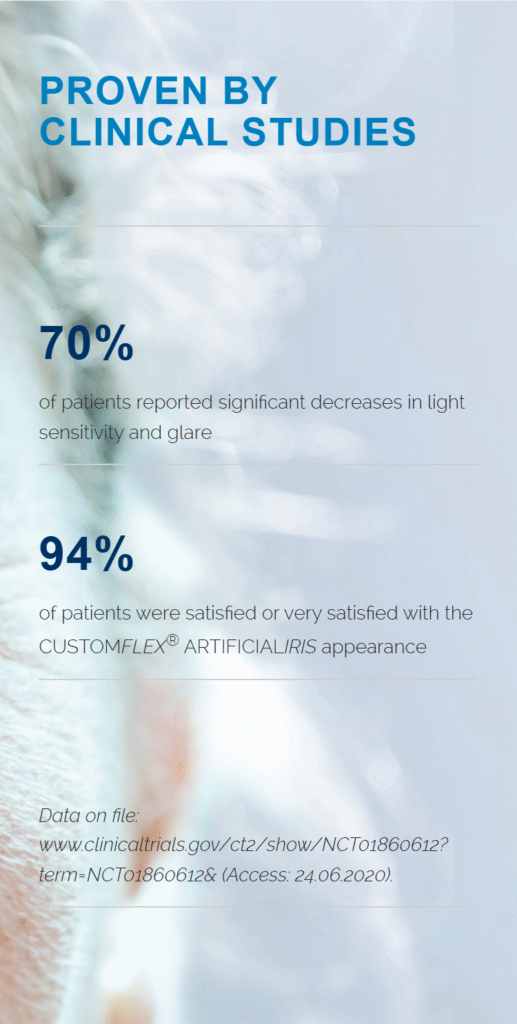
CLINICALLY CONFIRMED
The clinical effectiveness of the CUSTOMFLEX® ARTIFICIALIRIS is confirmed by studies. The implant is accredited by CE marking and FDA (U.S. Food and Drug Administration) approval.
THE ARTIFICIALIRIS by HumanOptics
- reduces photic phenomena
- enhances contrast sensitivity
- eliminates transillumination defects
PINCIPLE OF ACTION
- Fixed aperture of 3.35 mm
- Opaque black posterior surface to absorb light completely
WHAT DO THE EXPERTS SAY?
IKE AHMED, MD, UNIVERSITY OF TORONTO, CANADA
“ARTIFICIALIRIS is a device designed to correct the subjective symptoms of aniridia, including photophobia and glare, and to provide an excellent cosmetic result […]. It is a highly versatile tool in anterior segment reconstruction as it can be folded and injected into the capsular bag or sutured to the sclera.”
Gooi P, Teichman J, Ahmed I. Sutureless intrascleral fixation of a custom-tailored iris prosthesis with an intraocular lens. J Cataract Refract Surg 2014; 40:1759–63.


PETER SZURMAN, MD, AUGENKLINIK SULZBACH, KNAPPSCHAFTSKLINIKUM SAAR, GERMANY
“The artificial iris prosthesis sets a new standard in the reconstruction of complex anterior segment pathologies with partial or complete aniridia. Our patients benefit from improved visual funktion, reduced glare and a satisfactory cosmetic appearance. The latter is important and legitimate, considering that trauma patients are mostly young and long for a cosmetically acceptable outcome.”
Personal statement, 2019.

Application
AS VERSATILE AS YOUR PATIENTS
The ARTIFICIALIRIS from HumanOptics allows a maximum of patient-specific care. In addition to the appearance, the application options can also be flexibly adjusted to the anatomy and initial situation of the affected eye.
THE STANDARD CARE
ARTIFICIALIRIS Fiber Free
Developed for cases without suture fixation. Suture fixation possible with appropriate technique.

FOR SPECIAL INDICATIONS
ARTIFICIALIRIS with Fiber
For cases where suturing is indicated.

INJECTABLE
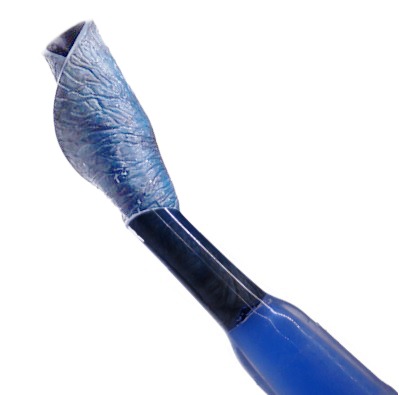
The ARTIFICIALIRIS from HumanOptics is made of highly biocompatible flexible silicone. It can be folded and rolled for insertion through small incisions. The model ARTIFICIALIRIS Fiber Free can be injected through qualified injector systems.
CUSTOMIZABLE
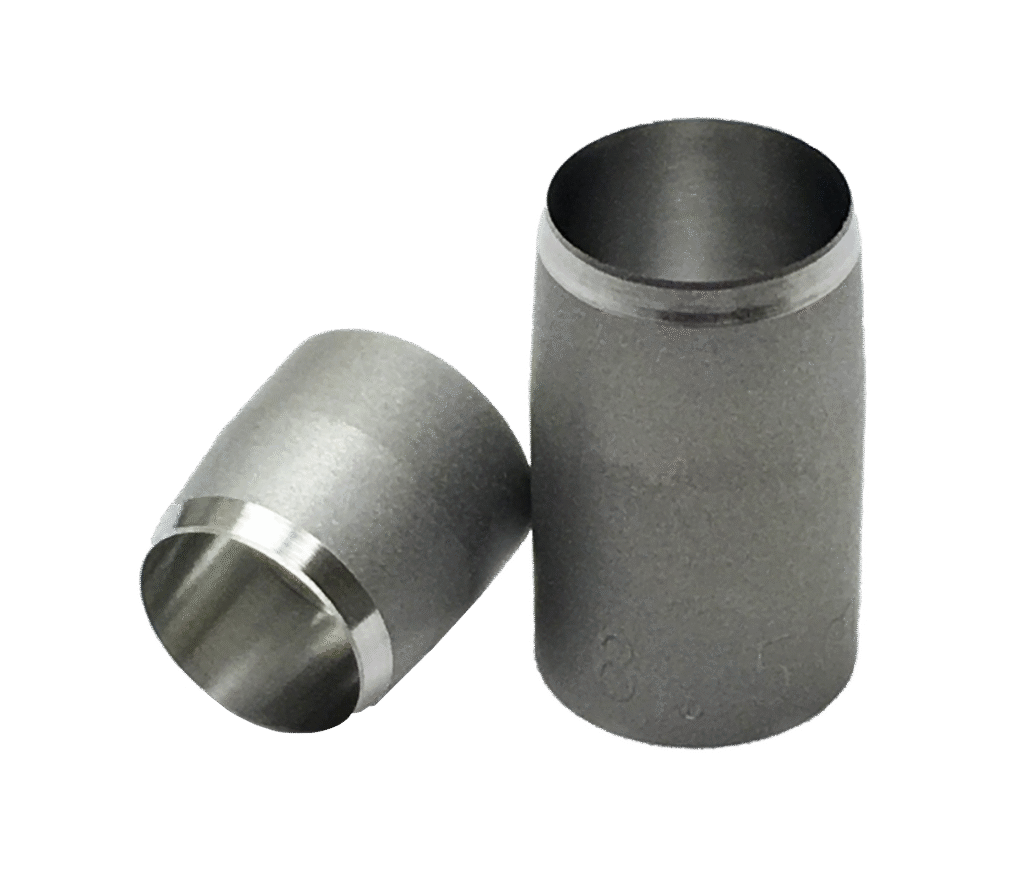
The ARTIFICIALIRIS from HumanOptics can be customized in shape and size to the respective iris defect by using of trephines.
Also see our selected range of trephines:
- Diameter
9.0-12.5 mm - Steps
0.5 mm
FLEXIBLE
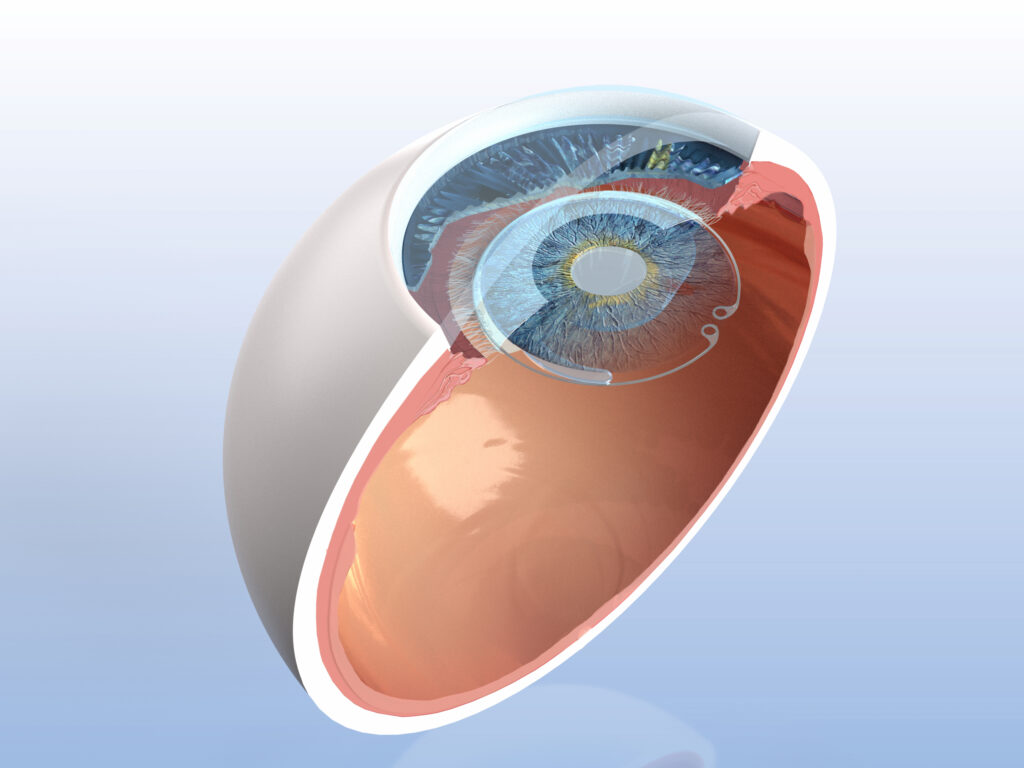
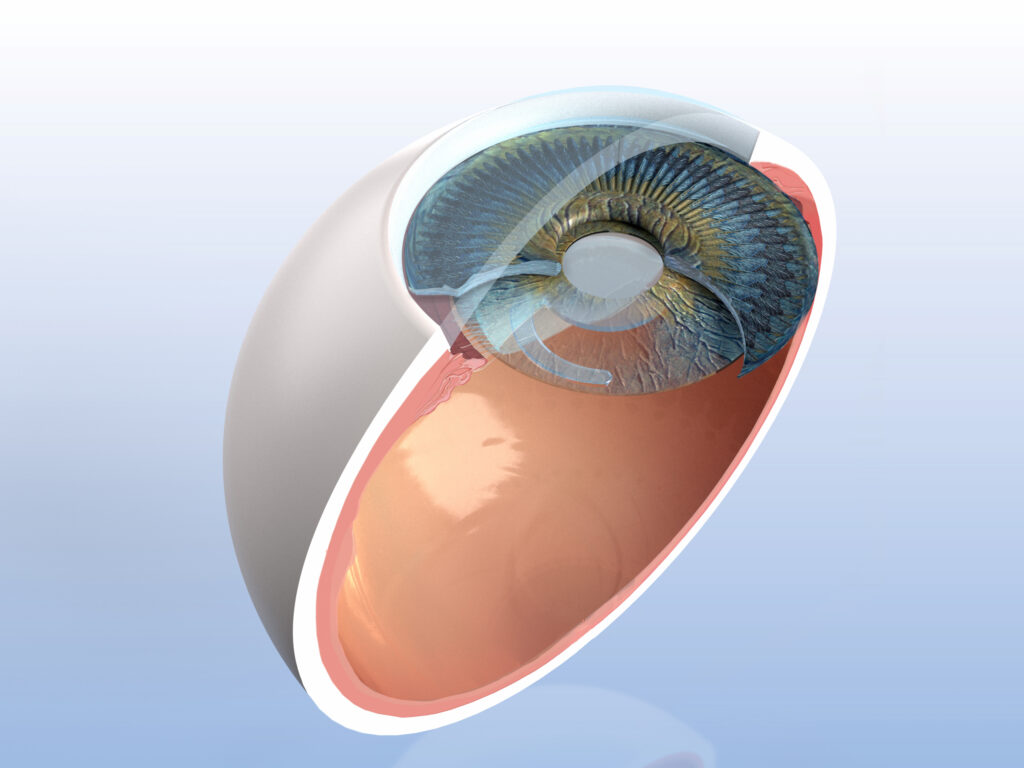
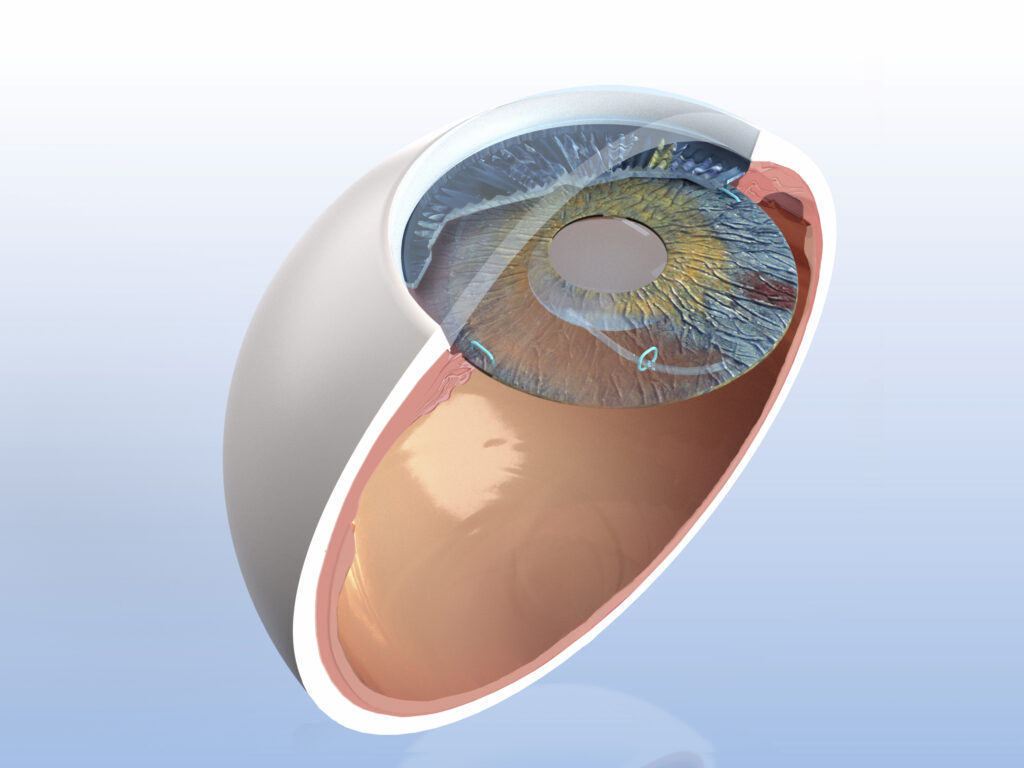
The ARTIFICIALIRIS from HumanOptics allows a variety of implantation methods, adapted to the specific conditions of the affected eye. Remain flexible – even during the procedure. The iris implant can be combined with almost all IOL models.
WHAT DO THE EXPERTS SAY?

STEPHAN KAMINSKI, AUGENKLINIK ZÜRICH WEST, SWITZERLAND & AUGE UND LASER WIEN, AUSTRIA
“Until now, iris reconstruction was a challenging surgical procedure requiring large sclerocorneal incisions and often resulting in poor cosmetic outcomes. With the ARTIFICIALIRIS, small self-sealing incisions are possible, enabling fast visual recovery and excellent cosmetic outcomes. The device may be used for complete or partial iris reconstruction.”
Kaminski S. Iatrogenic coloboma, aniridia, and aphakia. J Cataract Refract Surg Today Europe 2012; July/August: 52–54.

MICHAEL E. SNYDER, MD, CINCINNATI EYE INSTITUTE, USA
“A patient … suffered severe, disfiguring damage to her eye in a car accident as a young child. Now in her 20s, the young woman recently underwent implantation of a HumanOptics artificial iris. She called to tell me that receiving the artificial iris was one of the best things that had ever happened to her …. She still calls or sends a note periodically just to remind me and my team of her happy result.”
Doran M, contributing writer interviewing Miller K, Rosenthal K, Sikder S, Snyder M. Anterior segment iris implants advance – but face continuing challenges. American Academy of Ophthalmology, EyeNet, 2013; Issue February: 29–31.